
Bespoke ceramic sculptures and objects
The relationship between familiarity and novelty, the design approach behind four collections, and creating a family for a particular space through different ceramic pieces that share a common language.

Design notes, Oğuz, deramic
When looking for a ceramic sculpture or design object for a hotel lobby, a store's reception area or an architectural project, the character we want the piece to bring to the space is itself a design question. A more familiar, organic expression, or an unusual surface in which digital design is clearly visible?
At deramic, we developed the Puncta, Scarpa and Coirra collections to explore different responses to this question. In Kavrea, which we designed later, we explored the effect of digital surfaces and sculptural forms at a larger scale. These collections form a body of knowledge about form and texture from which we can develop new pieces for a particular space.
Between the familiar and the new
Our reading in aesthetics was the starting point for the first three collections. We were particularly interested in the relationship between a design appearing new and feeling familiar. A form that seems unusual to one person may feel familiar to another. A person's background, culture and the objects they have encountered are part of how they interpret a design.
We designed Puncta, Scarpa and Coirra as three different approaches to this relationship. In Puncta, we aimed to emphasise a sense of novelty; in Scarpa, to bring a familiar understanding of mass together with complex geometries; and in Coirra, to establish a surface language that recalls traditional ceramics. This sequence was a direction we set when designing the collections, rather than a classification that everyone would perceive in the same way.
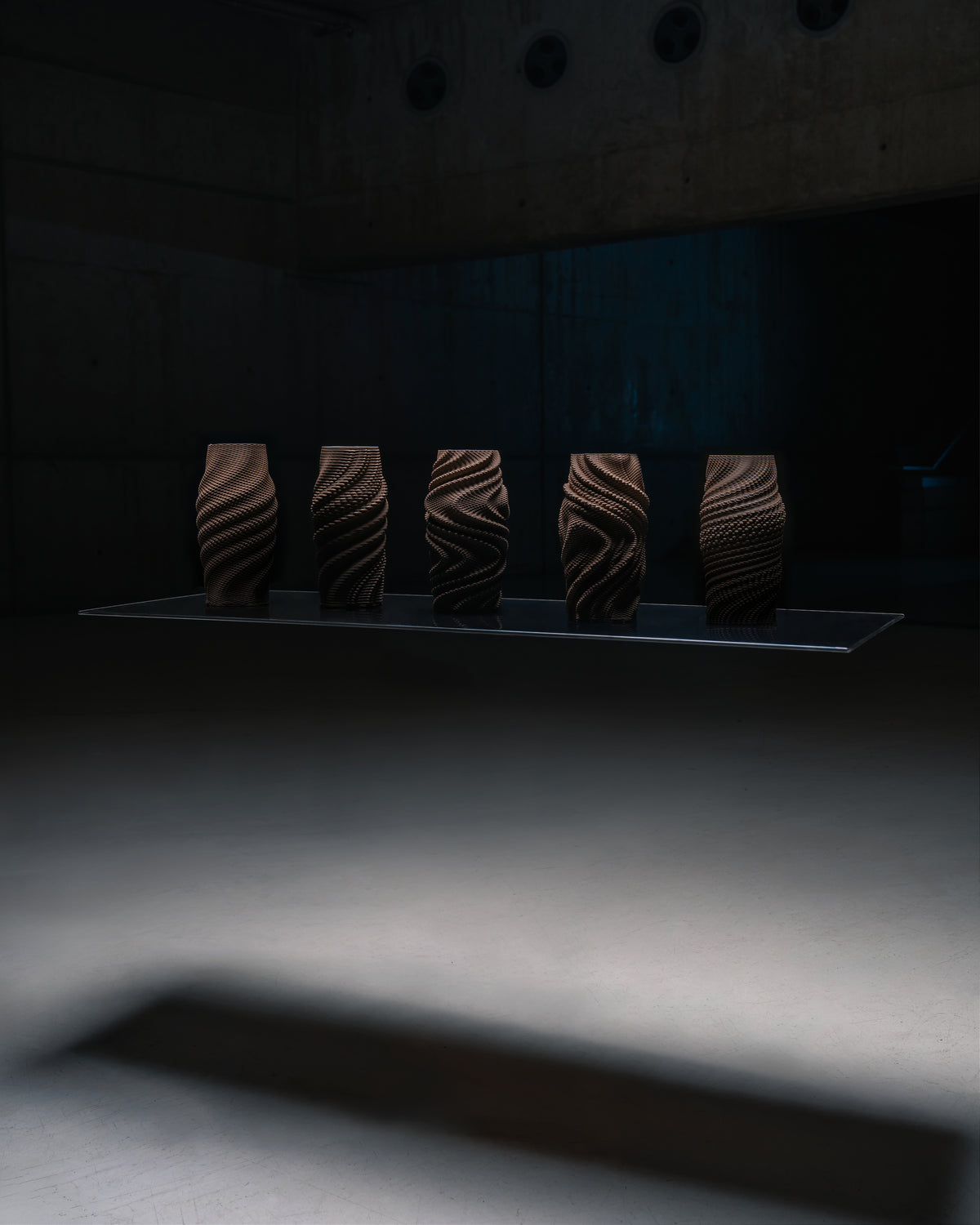
Puncta, different textures on the same form
Puncta was the series in which we explored the most unusual surfaces among the first three collections. Using parametric design tools such as Grasshopper, we developed different textures on the same form. Working with the possibilities of 3D clay printing, we placed complex surfaces formed by the printer's movements at the centre of the design.
In the five-piece series, the basic form remains the same while the dotted textures change. This allows us to create different characters through the rhythm of the surface without changing the form entirely. Puncta is also a study that helps us consider how pronounced or dense a texture might be when developing a design for a space.
Scarpa, a language of mass and void
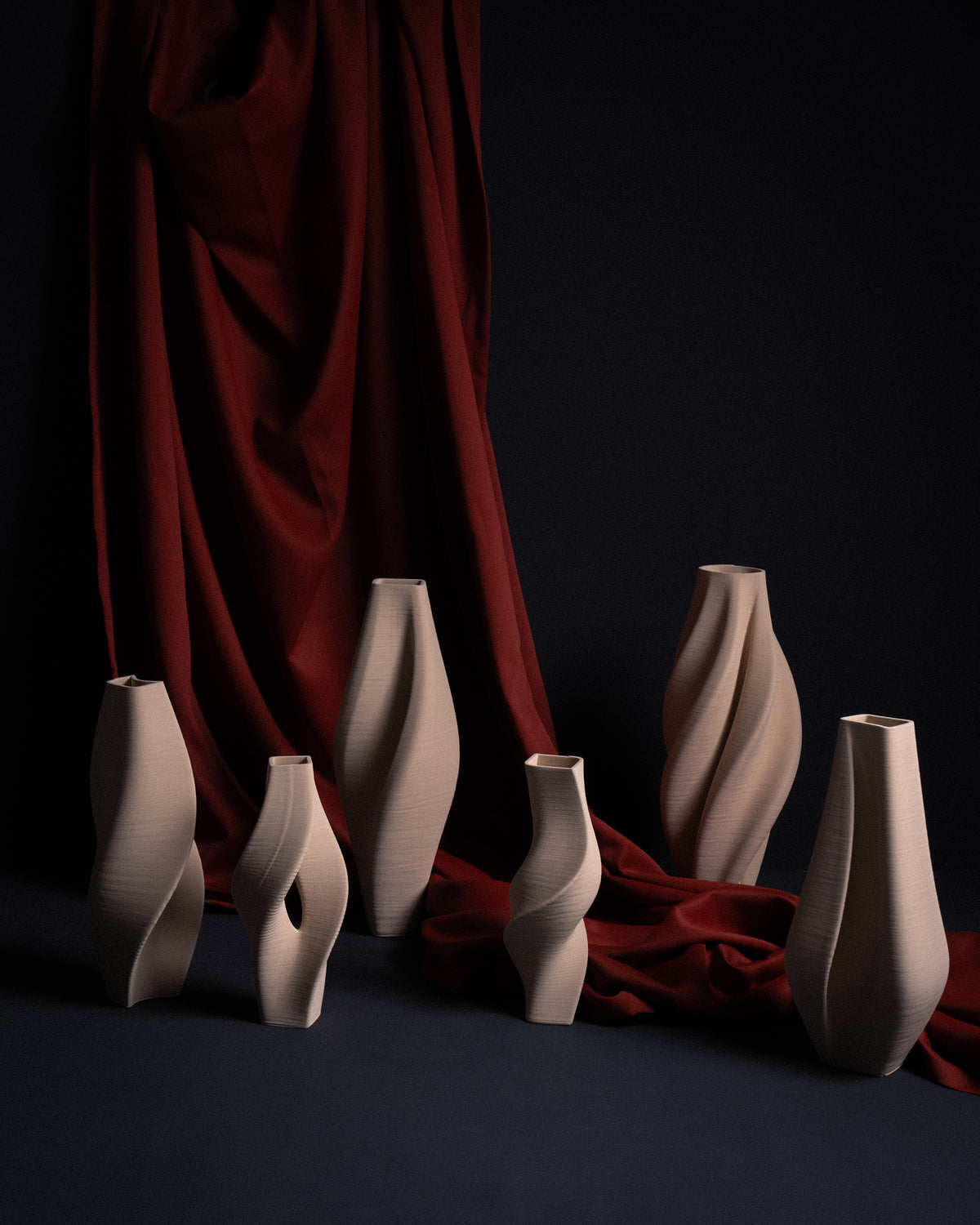
In Scarpa, we brought mass to the foreground while allowing the printer's individual layers to recede. Our aim was to bring a potentially more familiar approach to form together with complex geometries.
In this series, inspired by Carlo Scarpa, we gave voids as much importance as mass. Concave and convex surfaces make the way light meets the form from different directions, and the shadows that result, part of the design. Here, we establish the character of the surface through the depth of the geometry rather than the accumulation of lines.
Coirra, layers that recall the coiling technique
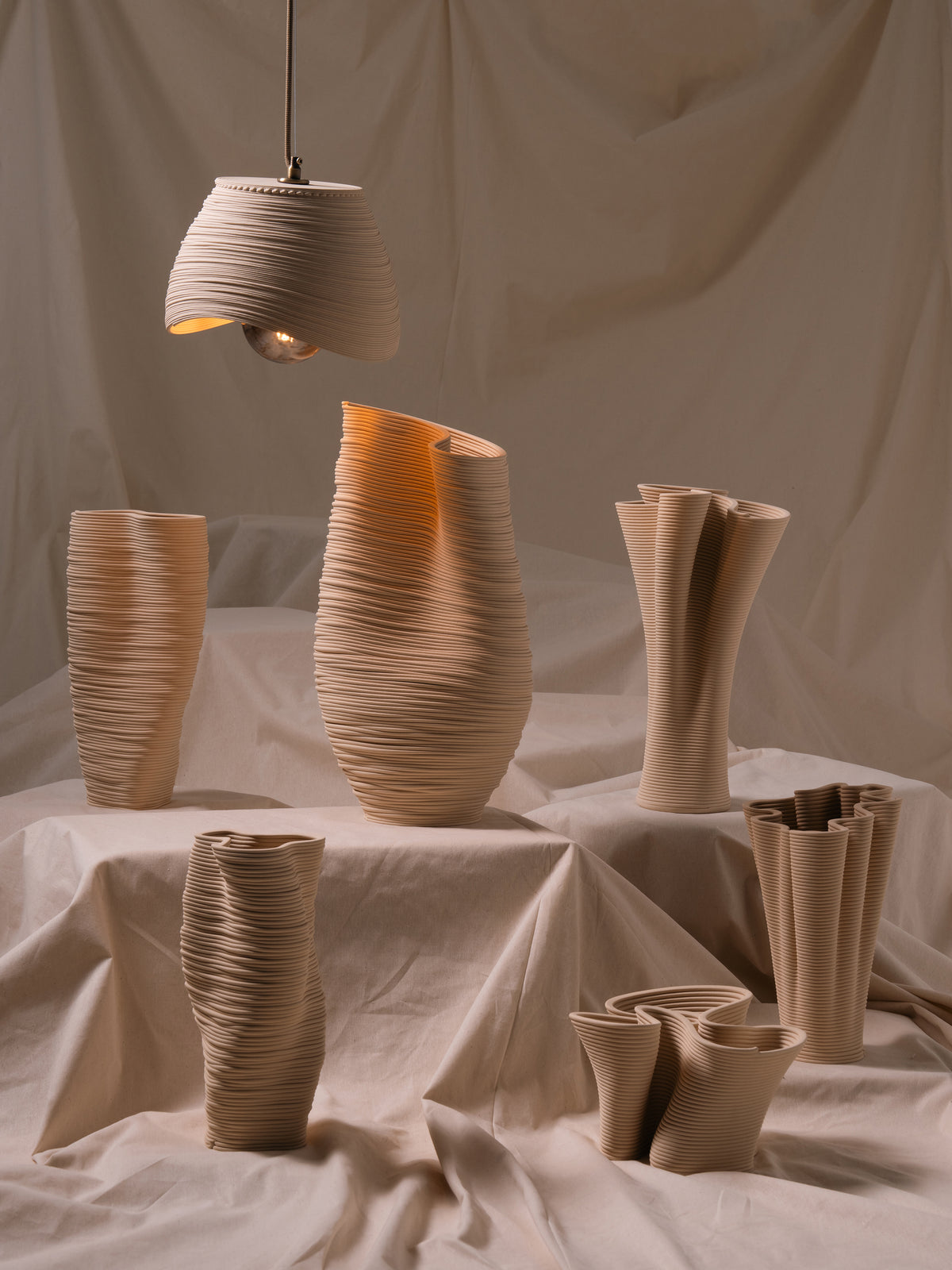
In Coirra, we sought a more familiar ceramic feel. One of our starting points was the traditional coiling technique, in which a form is built by placing coils of clay on top of one another. The layered structure of this method, also known in Turkish as the sucuk technique, became a reference for Coirra's texture.
We produce Coirra through 3D clay printing. By adding designed deviations to print paths that would otherwise stack regularly, we developed a surface that evokes handmade work. These deviations are deliberate design decisions applied to the path followed by the printer.
We moved towards organic transitions rather than sharp boundaries, and towards surfaces that appear to have been built up layer by layer. Through a digital production method, we aimed to evoke the visual memory of traditional ceramics.
What did we hear from people who saw the collections?
When designing the three series, we were also curious about how people would respond to these differences. In some respects, the reactions we received were close to our expectations: Puncta's unusual character stood out, while Coirra was received as a more familiar-feeling series.
We regard these as observations and feedback gathered while developing the collections. Rather than deriving a ranking of preferences that applies to everyone, we are trying to understand how different design languages resonate with different people.
Kavrea, the sculptural expression of a digital surface
In Kavrea, we wanted to make the relationship between ceramics and digital design more visible. Through surface operations developed in Grasshopper, we introduced waves and folds into the form. Kavrea I and II emerged by varying these surface relationships parametrically.
We continued the digital design approach in the base geometries. Here, we used a generative algorithm known as Differential Growth. By considering the formation of the surface and the base together, we explored the expression of digital ceramics at a larger scale.


A bespoke collection from a shared design language
What matters to us about parametric design is the ability to develop different pieces that share the same language. We can make the folds of a surface larger or smaller, increase or reduce the density of a texture, and combine different forms with different surfaces. These variables open up a wide range of possibilities for creating a new design family around a space.
For a hotel, restaurant or store, we can work on a single sculptural object or develop different pieces that share a common character. The existing collections provide concrete starting points to consider when discussing what the space needs.
In single-piece production, we can make ceramic bodies up to approximately 60 cm in height. For larger sculptural forms, our modular system allows us to design and produce bespoke work at heights such as 1.5, 2 or 3 metres. We assess the intended dimensions, the form and the connections between the pieces together.
What effect are you looking for in your space?
We can begin with a collection's texture, a particular form or the feeling you want to create in a space. Photographs or a plan of the space, approximate dimensions and where the piece will be used help make the first conversation more concrete. We bring design and ceramic production together in our Ankara studio. You can share your needs with us as a project owner or architect.
Read how we begin a bespoke design for a space
Connections with research in aesthetics
Hekkert, Snelders and van Wieringen's study of product design shows that novelty and typicality can contribute jointly to aesthetic preference. Typicality here describes the extent to which a product represents the category it belongs to; it does not correspond exactly to the everyday notion of familiarity. This research provides a basis for considering different design languages together, rather than prescribing a single ratio that applies to everyone. Hekkert and colleagues, 2003
Darda and Cross's study of paintings and dance shows that patterns of preference associated with culture and expertise can differ between art forms. We treat these sources as conceptual background to our design question. The feedback we describe about our collections comes from our own studio observations. Darda and Cross, 2022